Table of Contents
ToggleCurious about why certain writing jumps off the page and others are flat? It is usually the secret of one particular language that sets it afire and gives it a richness whose commonplace words are transformed to strong phrases. Figurative Language: A Beginner’s Guide describes how this device transcends literal meaning and triggers the imagination and emotion in a way that simple language is unable to do.
The first question that a lot of beginners pose is What is figurative language, and why does it matter? This guide dissects it into easy-to-understand bits, making mastering the basics a lot easier, and you can begin writing with flair. At the conclusion of this article, you will know the main kinds and how to use them to make your writing more interesting and impressive.
What is Figurative Language?
In simple terms, it is a manner of creativity in using words in order to transcend their literal usage. It enables authors to depict powerful images, convey feelings, and ideas that become easier to remember. This definition emphasizes the non-figurative use of words that can take an otherwise dull piece of writing into something more interesting and imaginative.
Types of Figurative Language Explained
- Simile: A simile is the comparison of two things that are not the same by means of the words like or as. In the example, phrases such as “Her eyes sparkled like stars” support the reader in imagining the brightness and the beauty that her eyes.
- Metaphor: The metaphor is a direct expression that something is something, and it forms a vivid image or thought. For example, there is the saying, “Time is a thief,” which implies that time can rob us of things.
- Personification: Personification gives human attributes or behaviors to the inanimate. A case in point is the wind whispered through the trees, which brings nature to life and makes it expressive.
- Hyperbole: Hyperbole is a form of exaggeration to make a point. A case in point, I am so hungry I could eat a horse, demonstrates the highest level of hunger in a fun, catchy manner.
- Symbolism: Symbolism is the act of applying objects, characters, or actions to symbolize a richer idea or theme. An example is that a dove is usually a representation of peace.
- Alliteration: Alliteration refers to the use of the same sound at the start of words, and it makes words rhythmic or sound musical. e.g., “Peter Piper picked a peck of pickled peppers”.
Such types make writing more vivid and expressive, and interesting to the readers.
Figurative Language Definition for Beginners
To put it simply, it can be described as a form of expressing the ideas more creatively than a direct meaning. It makes writing and speech more interesting, and it has an appeal to the feelings of people. It is used daily by poets, storytellers, or even leaders in order to make their words more vivid and memorable.
Human beings in all cultures have always appreciated the use of this form of expression in order to communicate ideas in an effective and clear manner. It can create an ordinary sentence and make it visible or touchable in the minds of the reader. It also renders stories and messages more interesting and entertaining to read.
With some use of this, anyone can create ways of communicating ideas in a manner that people remember longer, and understanding the figurative language definition helps in using these expressions effectively.
Learn creative expressions useful for essays and assignments
Figurative Language Examples You Should Know
An example is the most effective method PD teaching beginners how these functions work. They demonstrate how writers and speakers use creative words to clarify ideas, make them more vivid, or easier to remember. Through the examination of simple examples, one can better see how they can make writing come alive.
- “Time is money” – compares time to wealth, showing its value.
- “The wind whispered” – gives nature human qualities, making it more vivid.
- “He runs like the wind” – uses a comparison to show speed.
- “She has a heart of gold” – describes someone as very kind using a metaphor.
- “I’m so hungry I could eat a horse” – exaggerates for emphasis using hyperbole.
Why does this still matter
Words are still strong even in the digital age, where visuals, memes, and emojis take up the entire culture. This language is still very important in the process of communication, as it aids individuals to bond, motivate, and make ideas memorable. Although graphics are useful, they just cannot substitute the richness and the emotional appeal that this language can offer.
The following is why it is not irrelevant yet:
- Digital culture makes a lot of use of visuals, but words are not weak.
- Figurative words cannot be completely substituted with emojis.
- Leaders motivate with colourful phrases.
- It is employed by the teachers to make lessons exciting.
- This guide will demonstrate its timeless value.
The Role of Figurative Language in Storytelling
This is important in storytelling and makes stories vivid and enabling readers to identify with characters, setting, and feelings. It makes even the most captivating storyline one-dimensional. The figurative expressions provide imagery, feelings, and make the stories more memorable to writers.
These are how this language creates a better story:
- Works that lack figurative words are dead.
- Metaphors make lasting mental images.
- And through personification, the characters are more detailed.
- Scenes are easy to relate to because of similes.
- Readers relate more when images are used in telling stories.
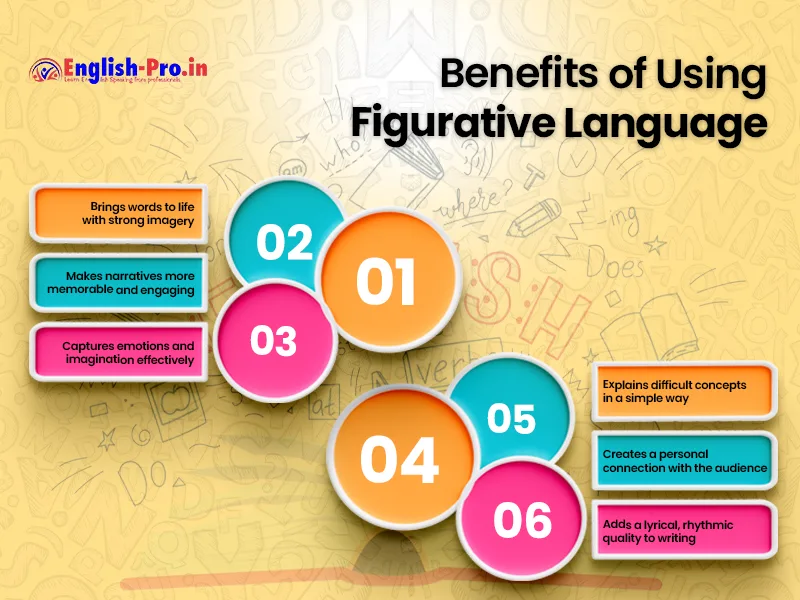
Benefits of Figurative Language for Communication
This is a great communication tool that enables speakers and writers to communicate with their audience on a more personal level to improve communication Skills. Creative expressions may help make ideas clearer, speeches easier to memorize, and messages more emotional.
These are some of the main advantages of using these communications:
- It creates a good appeal.
- It makes speeches memorable.
- It encourages imagination.
- It simplifies complex ideas.
- It enhances better human relations.
Learn literary devices used in creative writing.
Future of Figurative Language
The use of this language will keep developing and defining communication even in the future. The artificial intelligence tools will provide imaginative figurative words, and social media will make new styles and trends go viral. Business executives will embrace symbolic communication as a means of reaching people better, and writers will embrace the use of these more often with images to enhance message delivery. This guide will equip you with these trends and explain why knowing them is vital to communication in a digital world.
Misuse of Figurative Language
- Overusing these can make writing unclear.
- Using mixed metaphors may confuse readers.
- Forced imagery can feel unnatural or distracting.
- Repeating figurative expressions too often reduces their impact.
- Maintaining balance ensures that it communicates effectively.
Tips for Beginners
- Begin by employing simple metaphors to make your writing more graphic.
- You should not make your messages too complicated to make your readers comprehend you.
- You should also write these daily so that you can perfect it.
- Study the figures of speech of contemporary authors.
- Figurative Language: A Beginner’s Guide will serve as a guide to the learning process.
Common Mistakes to Avoid
To ensure that your writing is effective, there are some frequent traps that you ought to avoid when using this language.
For example:
- One should avoid matching unrelated pictures, and this can be confusing to the readers.
- Use original and not cliched ideas in your professional writing goals.
- Make sentences brief and explicit so that you can make sure your message is grasped. Combine figurative tone with context in order to make it fitting.
- Editing your writing to make it clear is always a great idea since your figurative expressions must contribute, but not confuse.

Conclusion
Figurative words are the life-givers of the bland language and help to make simple sentences bright, memorable. Figurative Language: A Beginner’s Guide advises amateurs to read several examples regularly and familiarize themselves with each type to increase their writing ability. Daily practice, even in everyday writing, can make of great difference in your effectiveness in communication.
Why wait? Take a step now and start using it in your conversations or writing today!
To learn more and master it check out English Pro.
Also, you can visit our office at Level 3rd SCO 23-24-25, Sub. City Center, Sector 34A, Sector 34, Chandigarh, 160022, or call us at 99-1464-1983.
Start your journey toward powerful, memorable communication today!

J. Julia Kamei
J. Julia Kamei is a professional content writer with 4+ years’ experience creating impactful content for clients in the USA, India, Canada, the UK, and Europe. An M.A. History graduate, she specializes in immigration, business, IT, digital marketing, AI, and Data Science. She also mentors students for international education and research.